Continue beyond contact
Create accountable work when the customer outcome requires research, approval, fulfillment, or follow-up.
Manage governed case lifecycles, ownership, tasks, business-calendar SLAs, related records, approvals, and customer acceptance as part of the original service journey.
Case Management
Resolution beyond the conversation
Case OCX-2418
Billing adjustment review
Customer and conversation linked
For 01
CX leaders
For 02
Case operations
For 03
Back-office leaders
Case responsibility
Cases continue governed service across conversations, tasks, approvals, teams, systems, and customer acceptance.
Create accountable work when the customer outcome requires research, approval, fulfillment, or follow-up.
Manage tasks, owners, milestones, related records, and approvals through a governed lifecycle.
Apply business calendars, warning thresholds, pause rules, and escalation to time-sensitive work.
Case lifecycle
Published case types keep state, required work, routing, milestones, and closure behavior reviewable.
Open the case from an interaction, automation, API, or authorized user action.
Route owned tasks, milestones, approvals, and related work through the lifecycle.
Record the resolution, customer acceptance, outcome, and retained history.
Keep complex service work accountable after channel handle time ends and until the customer outcome is complete.
Case operating model
Configure the case definition separately from daily agent work, supervisor operations, and external customer participation.
Define how governed work is created and what it must contain.
Publish versioned case types, fields, forms, lifecycle, policies, workspace, and validation.
Create and link cases from interactions, automation, APIs, portals, or authorized users.
Apply customer/account service grants, priorities, calendars, and milestone commitments.
Keep complex work owned across teams and systems.
Assign independent work to agents, teams, queues, skills, and governed approval paths.
Retain conversations, communication, notes, attachments, participants, knowledge, and decisions.
Link related records, coordinate major conditions, and preserve history through merge or split.
Make time, outcome, workload, and evidence operationally visible.
Track milestones, warning thresholds, pauses, breaches, escalation, and entitlement policy.
Support information requests, comments, attachments, status, and acceptance through safe projections.
Review backlog, breach risk, workload, process performance, worklogs, cost, and recovery evidence.
Role-specific workflows
Product responsibilities stay connected without collapsing administrators, operators, agents, and reviewers into one generic persona.
Case worker
01Investigate, communicate, complete tasks, coordinate dependencies, and close with evidence.
Service designer
02Own case types, forms, lifecycle, policies, SLAs, entitlements, workspace, and publication.
Operations leader
03Monitor queue conditions, breach risk, major cases, reassignment, and process outcomes.
Product evidence
Review where context, action, ownership, and control meet during the work.
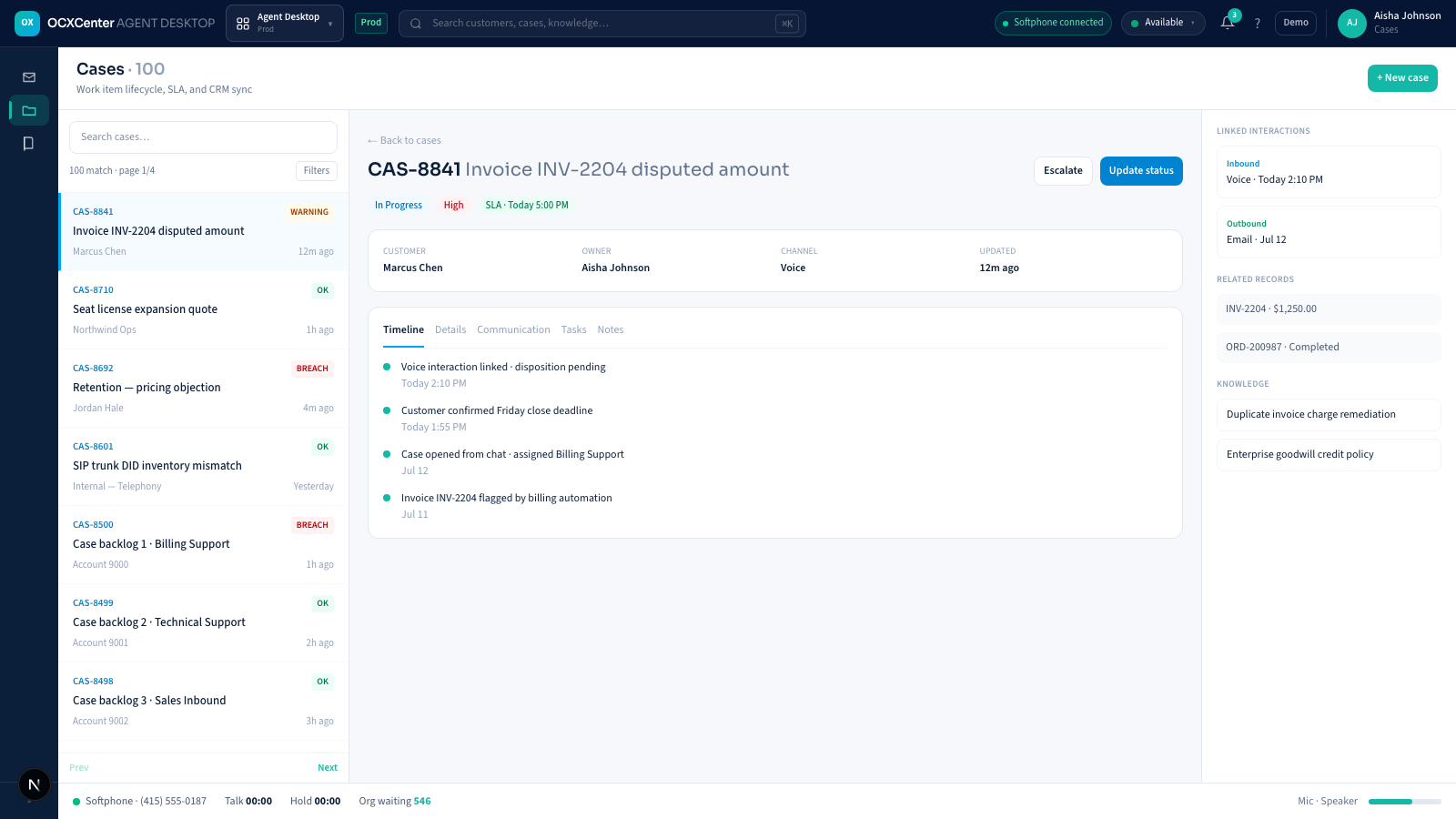
Case ownership, timeline, related records, knowledge, and SLA state in one resolution workspace.
Prioritized portfolio
Open work is ranked with warning and breach visibility.
Resolution timeline
Customer, automation, and agent actions share one history.
Related records
Interactions, orders, invoices, and knowledge remain linked.
Governed state
Ownership, priority, SLA, and status changes remain explicit.
Enterprise integration and governance
Review integration boundaries and governance controls together so deployment assumptions remain explicit.
Connected product family
Continue the customer journey.
Adoption path
Sequence configuration, integration, testing, and rollout around measurable service outcomes.
Define case types, states, roles, tasks, milestones, calendars, approvals, and closure requirements.
Link conversations, automation, APIs, customer context, routing, and downstream records.
Prove authorization, SLA behavior, concurrency, escalation, recovery, and customer acceptance before launch.
Evaluation questions
Evaluate it as one system