Answer with approved knowledge
Ground responses in authorized, versioned sources and make unsupported answers fail safely.
Combine typed intent, approved knowledge, structured data capture, governed actions, and contextual human handoff across digital and voice experiences.
Self-service automation
Order resolution journey
Delivery support
Customer verified
My order should have arrived yesterday. Can you check it?
Your shipment was delayed. I found the order and can request a replacement using the verified delivery address.
For 01
CX leaders
For 02
Journey owners
For 03
Automation and technology teams
Self-service responsibility
Automation owns understanding, structured collection, grounded answers, governed action, and contextual handoff.
Ground responses in authorized, versioned sources and make unsupported answers fail safely.
Collect typed information, apply deterministic policy, and invoke allowlisted actions through explicit tools.
Transfer intent, verified inputs, completed steps, and escalation reason into the assigned human workspace.
Automation architecture
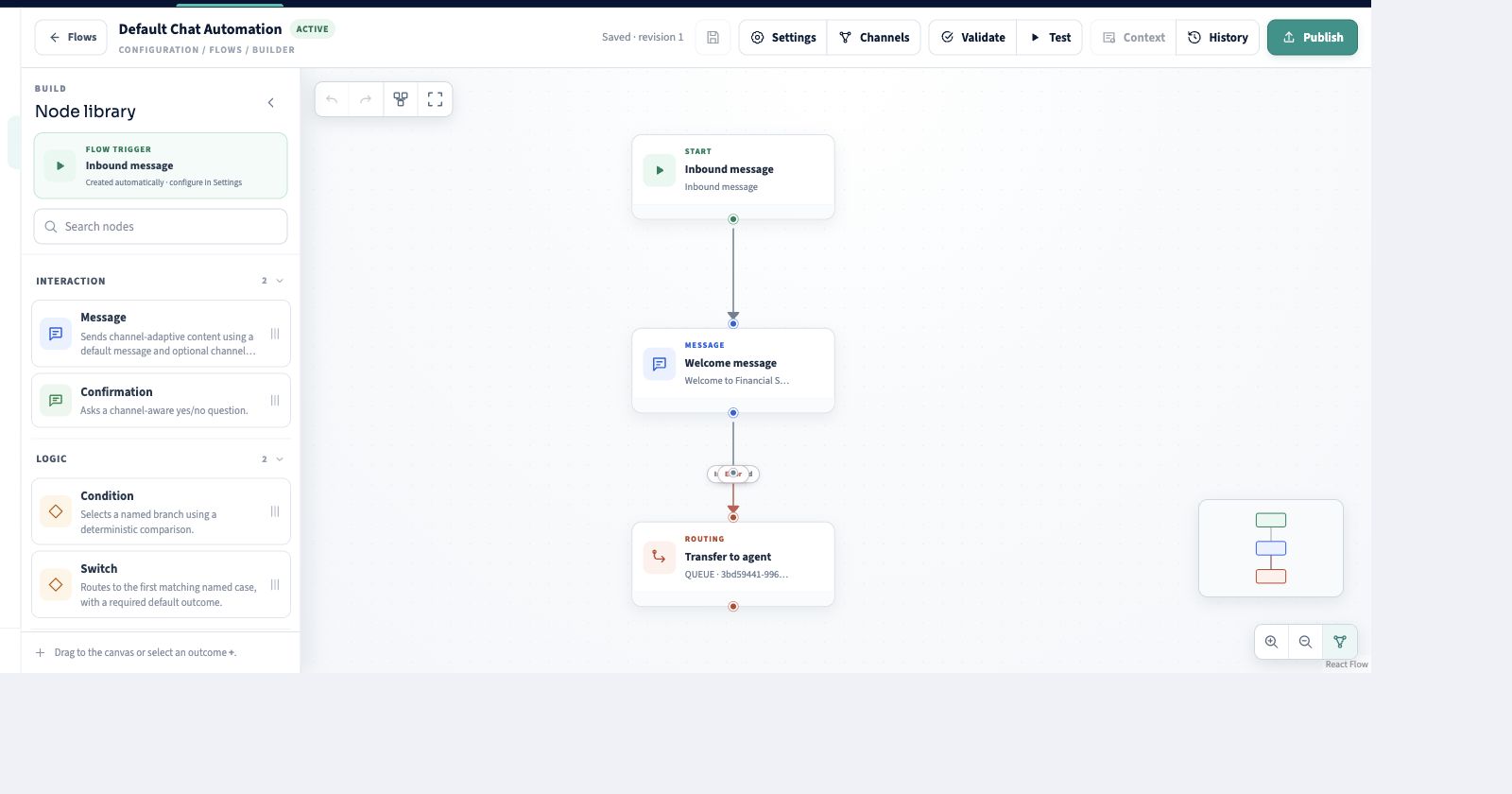
Flow Builder, AI coordination, typed tasks, actions, approvals, routing, testing, and release control are capabilities of Automation—not separate products.
Turn free-form customer requests into inspectable service goals.
Select, prioritize, switch, resume, cancel, or hand off customer journeys.
Model one customer goal with explicit inputs, outcomes, prerequisites, and failure paths.
Collect and validate typed information with provenance and correction history.
Keep every customer-changing operation visible and bounded.
Invoke pinned REST, MCP, or reusable-flow actions through typed schemas.
Bind approval to the exact payload and execution snapshot before sensitive work.
Transfer the goal, verified facts, completed actions, and reason for escalation.
Move controlled automation from authoring into dependable operation.
Design the graph and inspect logic, context, provider calls, and failure behavior.
Validate, approve, publish, promote, pause, and roll back immutable revisions.
Retain model route, tokens, latency, fallback, actions, delivery, and outcome evidence.
Runtime journey
AI interprets the request while durable workflows control validation, authorization, actions, recovery, and outcome evidence.
Classify intent and collect the minimum required context.
Answer, capture, or complete an approved service action.
Escalate with context when confidence, policy, or customer need requires it.
Expand self-service while keeping knowledge, action authority, provider use, and human handoff visible and reviewable.
Product evidence
Review where context, action, ownership, and control meet during the work.
Versioned automation with validation, testing, routing, and controlled publication.
Explicit journey logic
Deterministic nodes and managed AI steps share one model.
Human handoff
Routing is a visible part of the journey rather than a hidden script.
Lifecycle controls
Validate, test, review history, and publish through defined gates.
Version evidence
Published behavior remains traceable to an immutable revision.
Role-specific workflows
Product responsibilities stay connected without collapsing administrators, operators, agents, and reviewers into one generic persona.
Journey owner
01Own the customer goal, eligible outcomes, escalation policy, and success measure.
Automation designer
02Model coordination, typed collection, actions, approvals, and provider behavior.
Operations reviewer
03Review readiness, traces, failures, handoffs, budgets, and customer outcomes.
Enterprise integration and governance
Review integration boundaries and governance controls together so deployment assumptions remain explicit.
Connected product family
Continue the customer journey.
Adoption path
Sequence configuration, integration, testing, and rollout around measurable service outcomes.
Start with a bounded intent, clear authority, and measurable outcome.
Bind approved knowledge, typed inputs, tools, policies, and handoff rules.
Validate unsupported answers, provider outages, consent, retries, and agent continuation.
Evaluation questions
Evaluate it as one system