Identity and access
Workspace membership, role capability, session behavior, and provider-certified enterprise identity.
Enterprise security
Security follows the customer journey through tenant-scoped authorization, explicit provider boundaries, governed change, purpose-limited evidence, and deployment review.
Production posture depends on the selected deployment, providers, operating procedures, and applicable customer agreement.
Security model
The website distinguishes available product controls from provider and deployment responsibilities.
Workspace membership, role capability, session behavior, and provider-certified enterprise identity.
Tenant transactions, row-level security, scoped storage, and fail-safe cross-tenant behavior.
Versioned configuration, immutable publications, idempotency, correlation, and audit history.
Approved providers, scoped projections, redaction, evaluation, human review, and explicit fallback.
Purpose-scoped access, retention policy, legal hold, export, playback, and support-bundle boundaries.
Health, metrics, traces, structured logs, readiness gates, backup, recovery, and incident evidence.
Control in the workflow
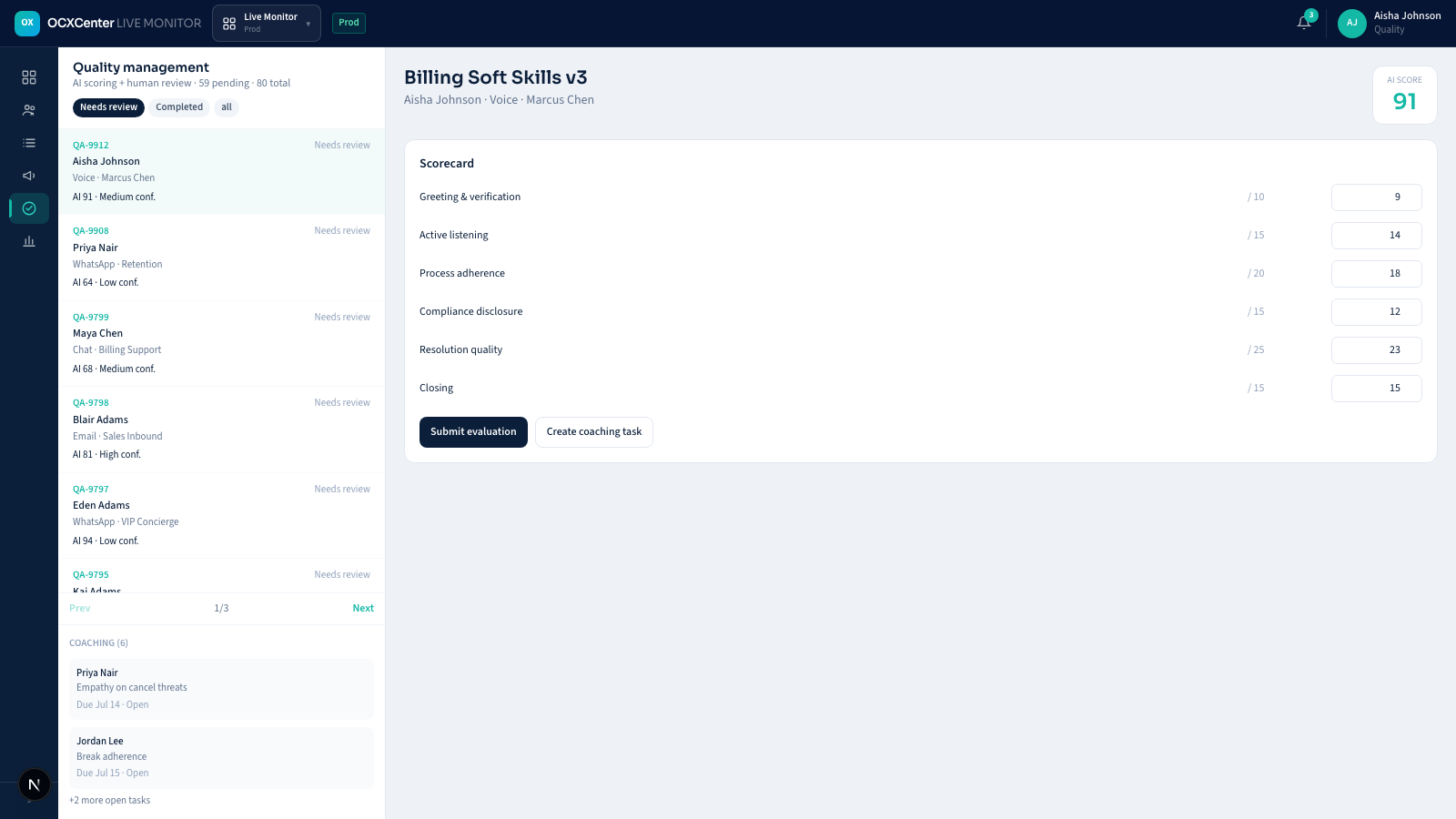
Evaluation, AI confidence, human review, coaching, and final action are presented as part of the operating workflow—not hidden behind a trust badge.
Human review, structured scorecards, AI evidence, and coaching follow-through.
Review population
Evaluations are prioritized with confidence and status context.
Defensible rubric
Weighted criteria keep evaluation logic visible to reviewers.
Human decision
AI scores support rather than replace the accountable reviewer.
Coaching action
Evaluation findings can become owned coaching work.
Evidence boundary
Security claims identify the current product behavior, external provider requirement, deployment validation, and contractual boundary without exposing internal delivery labels.
Request current evidenceWorkspace membership, authorization, tenant transactions, row-level security, and scoped storage boundaries protect tenant data paths.
Enterprise identity behavior uses explicit SAML/OIDC, MFA, SCIM, and session boundaries certified with the selected provider.
Versioned configuration, immutable publications, idempotent mutation paths, correlation, and audit events keep operational change reviewable.
Approved providers, scoped data projections, confidence handling, editable outputs, and explicit human confirmation govern AI-assisted work.
Hosting region, storage location, backup, recovery, observability, and provider endpoints are validated for each proposed deployment cell.
Availability, support, retention, recovery objectives, status communication, and service responsibilities are defined in the customer agreement.
Enterprise evaluation
We tailor the walkthrough to your operating model, current stack, provider constraints, and governance requirements.