Platform · Campaign Management

Plan and operate governed outbound engagement

Coordinate audiences, channel identity, schedules, pacing, suppression, compliant execution, agent work, callbacks, and outcomes through one versioned campaign lifecycle.

Campaign Management

Governed outbound program

Governed workspace

Operating mode

Preview

Primary channel

Voice

Run authority

Supervisor

Attempt stageOwnerEvidence
Eligibility and suppressionCampaignPolicy decision
Agent previewDesktopAccept or decline
Outcome reconciliationRuntimeDisposition + callback
TESTSynthetic contacts stay outside production reporting and frequency history.

For 01

Outbound operations

For 02

Contact-center leaders

For 03

Risk and compliance teams

Outbound operating model

Move from governed audience to reconciled outcome.

Preparation, execution, callbacks, and provider outcomes remain part of one versioned campaign lifecycle.

  1. 01

    Prepare

    Validate the audience, identity, schedule, channel, policy, and pinned revision.

  2. 02

    Execute

    Pace eligible attempts through compliance, routing, Voice Runtime, or a published flow.

  3. 03

    Reconcile

    Apply outcomes, retries, callbacks, opt-outs, and immutable operational evidence.

Connect proactive engagement to explicit audience, compliance, pacing, routing, and outcome evidence instead of operating separate dialer and campaign silos.

Campaign capability

Operate proactive engagement without creating another contact center.

Reuse shared identities, channels, routing, Agent Desktop, automation, dispositions, and analytics.

01Versioned audiences
Pin validated static, dynamic, or API-synchronized audiences to each run.
02Policy-aware execution
Bound pacing by compliance, provider readiness, queue capacity, concurrency, and campaign state.
03Five operating modes
Use preview, progressive, power, predictive, or agentless execution through one governed contract.
04Outcome and recovery evidence
Retain attempts, callbacks, retries, reconciliation, dispositions, and run revision history.
01

Audience and program design

Define who is contacted, why, when, and through which governed identity.

  • Source-led audiences

    Use CSV or API push, pull, or bidirectional synchronization with validated mapping.

  • Segments and versions

    Preview, deduplicate, pin, and reuse immutable audience and segment revisions.

  • Channel identity and schedule

    Select verified identities, timezones, windows, recurrence, and pacing policy.
02

Execution and agent work

Run the right operating mode through shared routing and channel services.

  • Five operating modes

    Support preview, progressive, power, predictive, and agentless execution.

  • Agent and automated paths

    Present scripts, forms, dispositions, or published Automation journeys by mode.

  • Callbacks and answer handling

    Coordinate retry, callback, voicemail, classification, and customer-requested timing.

03

Compliance and operations

Recheck safety at readiness and again before every attempt.

  • Consent and suppression

    Apply purpose, preferences, DNC sources, regional windows, and frequency controls.

  • Live operations

    Monitor readiness, progress, capacity, records, attempts, alerts, and bounded pacing changes.

  • Outcome reconciliation

    Resolve callbacks, ambiguous provider states, dispositions, retries, and immutable run evidence.

Role-specific workflows

Separate campaign design, compliance, and live operation.

Product responsibilities stay connected without collapsing administrators, operators, agents, and reviewers into one generic persona.

Outbound operations

01

Design the program

Own audience, identity, schedule, pacing, mode, script, form, and desired outcome.

  1. 1Prepare the audience
  2. 2Configure execution
  3. 3Run a guided test

Risk and compliance

02

Authorize eligible outreach

Own purpose, consent, suppression, jurisdiction, frequency, and launch requirements.

  1. 1Review policy sources
  2. 2Validate attempt controls
  3. 3Approve production readiness

Supervisor and agent

03

Operate live engagement

Monitor campaign health and handle authorized preview, callbacks, and dispositions.

  1. 1Review live readiness
  2. 2Accept and handle work
  3. 3Reconcile outcomes

Product evidence

See the operating moment—not another feature wall.

Review where context, action, ownership, and control meet during the work.

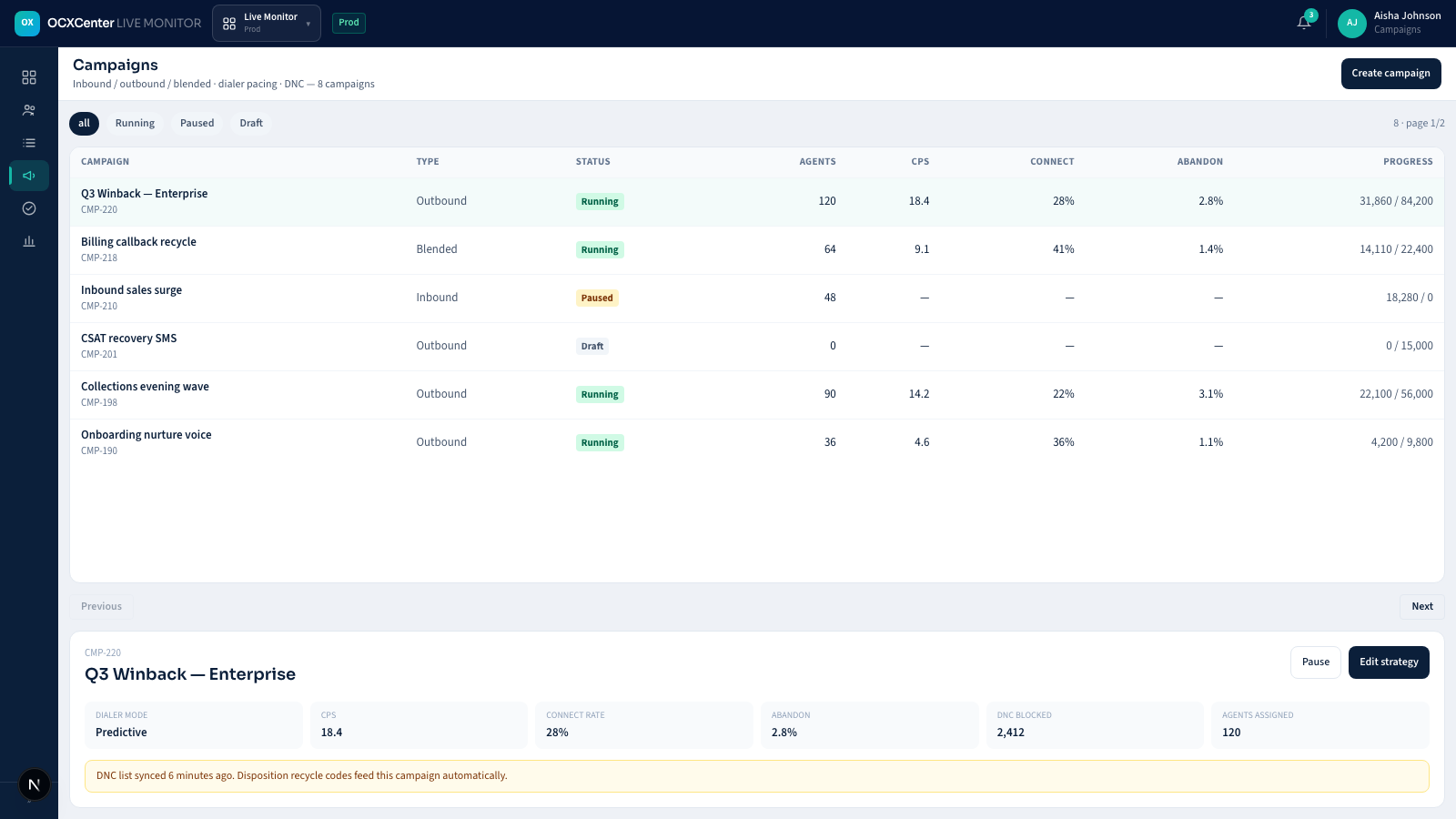
Campaign portfolio, readiness, audience progress, channel context, and governed run controls.

  1. 01

    Campaign portfolio

    Channel, mode, state, and owner remain visible across active programs.

  2. 02

    Readiness context

    Audience, identity, schedule, policy, and provider dependencies inform launch.

  3. 03

    Audience progress

    Contact progress and outcomes remain connected to the pinned run revision.

  4. 04

    Governed operation

    Start, pause, resume, stop, and test actions follow explicit permissions and evidence.

Enterprise integration and governance

Define authority, dependencies, and controls before launch.

Review integration boundaries and governance controls together so deployment assumptions remain explicit.

Integration boundaries

  • Campaign Management never originates directly with a carrier
  • Agent-assisted work reuses the existing routing and Desktop authority
  • Provider and jurisdiction certification remain named release gates

Governance controls

  • Single-use compliance grants
  • Destination leases and idempotent attempts
  • Immutable run and audience versions
  • Fail-closed provider and policy readiness

Connected product family

Continue the customer journey.

Where campaigns fit

Coordinate proactive service around a defined purpose.

Plan outreach for reminders, retention, collections, notifications, and follow-up without losing consent or outcome context.

01

Coordinate proactive service

Run reminder, retention, collections, notification, and follow-up programs from governed audiences.

02

Protect outreach policy

Re-evaluate consent, suppressions, calling windows, destination leases, and identity readiness before each attempt.

03

Connect agents and automation

Support preview, progressive, power, predictive, and agentless journeys through shared routing and flow boundaries.

  • One reviewable path from audience version to campaign outcome
  • Conservative pacing and compliance behavior under partial failure
  • Agent and automated outreach connected to the same service record

Adoption path

Start with one bounded workflow and expand with evidence.

Sequence configuration, integration, testing, and rollout around measurable service outcomes.

  1. 01

    Model the program

    Define purpose, audience, channel, mode, identity, schedule, dispositions, and compliance policy.

  2. 02

    Run a guided test

    Use synthetic contacts and non-production providers to verify routing, callbacks, suppression, and failure paths.

  3. 03

    Certify and expand

    Complete provider, legal, load, recovery, and operational evidence gates before wider rollout.

Evaluation questions

Resolve these before rollout.

  1. 01Which audience source and immutable version must each run use?
  2. 02Which jurisdictions, consent records, suppressions, identities, and calling windows apply?
  3. 03How will ambiguous provider outcomes and late callbacks reconcile without duplicate outreach?

Evaluate it as one system

Bring a real campaign management journey into the walkthrough.

Request a tailored walkthrough