Resolve fragmented identity
Give authorized teams one customer view while preserving the authority of CRM and core systems.
Resolve identities into a governed profile that keeps contact methods, consent, conversations, cases, and service history connected without making the browser a new source of truth.
Customer context operating journey
Resolve
Match the incoming identity to the authorized customer record.
Understand
Review consent, history, open work, and account context before acting.
Continue
Attach the new interaction and outcome to the shared customer journey.
For 01
CX leaders
For 02
Data and architecture teams
For 03
Privacy leaders
Where it fits
Connect this responsibility to the customer context, work, knowledge, policy, and evidence shared across OCXCenter.
Give authorized teams one customer view while preserving the authority of CRM and core systems.
Surface verified contact methods, permissions, and communication context before outreach or service action.
Keep conversations, cases, tasks, commitments, and outcomes connected as the journey changes channel or owner.
Product evidence
Review where context, action, ownership, and control meet during the work.
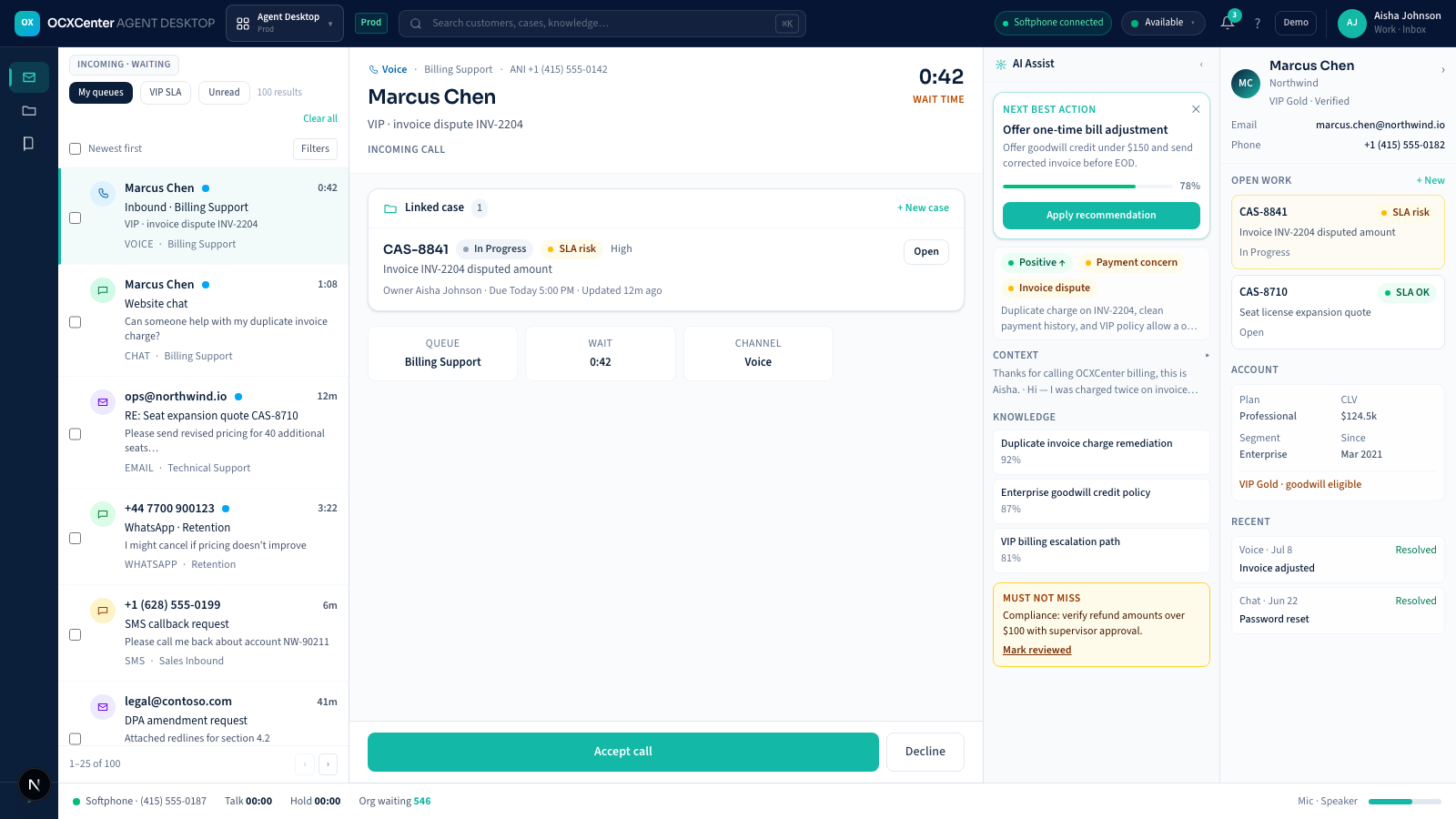
Prioritized work, case context, assistance, and customer history in one operating view.
Prioritized work
Enabled voice and digital work share one prioritized queue.
Linked resolution
Case ownership and SLA risk remain visible during intake.
Governed assistance
Next-best action and knowledge are presented for agent review.
Customer context
Identity, account, open work, and recent outcomes stay in view.
Operating capability
Capabilities connect to the same customer journey rather than operating as isolated add-ons.
How work moves
Every stage has a clear owner, transition, and retained evidence.
Match the incoming identity to the authorized customer record.
Review consent, history, open work, and account context before acting.
Attach the new interaction and outcome to the shared customer journey.
Give teams a consistent customer narrative without broadening access beyond the work they are authorized to perform.
Role-specific workflows
Keep responsibilities clear while the customer journey remains connected.
CX leaders
01Match the incoming identity to the authorized customer record.
Data and architecture teams
02Review consent, history, open work, and account context before acting.
Privacy leaders
03Attach the new interaction and outcome to the shared customer journey.
Adoption path
Sequence configuration, integration, testing, and rollout around measurable service outcomes.
Agree which systems own identity, profile fields, consent, interactions, cases, and outcomes.
Map scoped APIs and events, conflict behavior, access policy, and customer matching rules.
Validate representative journeys, authorization boundaries, stale data, and identity conflict handling.
Evaluation questions
Enterprise integration and governance
Review integration boundaries and governance controls together so deployment assumptions remain explicit.
Connected product family
Continue the customer journey.
Evaluate it as one system