Healthcare service
Coordinate patient communication without broadening sensitive-data access
Bring authorized identity, consent, secure collection, cases, and access-controlled evidence into a consistent service workflow while retaining deployment-specific obligations.
Designed for Patient access, technology, operations, and privacy leaders. All provider, deployment, and contractual requirements remain explicit.
Operating journey
Healthcare
- 01
Establish context
- 02
Coordinate service
- 03
Retain appropriately
Teams in the review
Patient access, technology, operations, and privacy leaders
Operating scenario
Follow one service journey end to end.
A patient request moves from digital intake to an authorized service representative and into structured follow-up without exposing data outside the required role boundary.
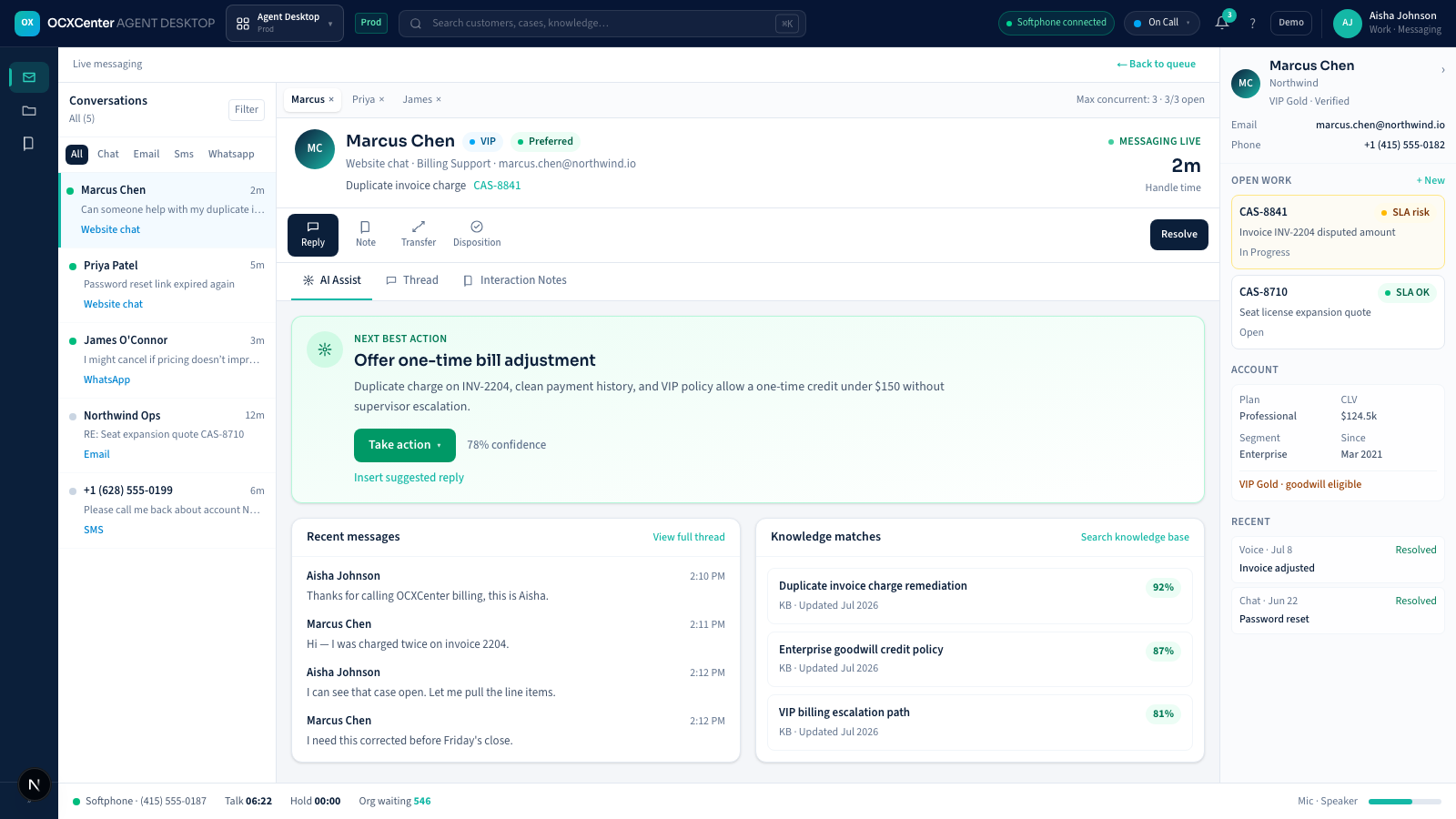
Concurrent digital work with the same customer, case, assistance, and knowledge context.
- 01
Concurrent work
Agents can move across active digital conversations.
- 02
Cross-channel context
Chat, email, SMS, and messaging share one customer record.
- 03
Suggested response
Assistance supports the agent without sending autonomously.
- 04
Resolution context
Open cases and prior outcomes remain connected to the thread.
Industry operating capabilities
Connect the journey to the responsibilities behind it.
The industry pattern stays useful only when product capability, system authority, and accountable operating ownership remain visible together.
- 01Minimum-necessary context
- Resolve only the patient or member information authorized for the active service purpose.
- 02Secure collection
- Use a dedicated customer form boundary for sensitive values and value-free agent progress.
- 03Coordinated follow-up
- Carry owned cases, tasks, milestones, and customer communication beyond the interaction.
- 04Policy-aware evidence
- Apply scoped access, retention, disclosure, export, and support controls.
Workflow
Make the operating sequence explicit.
The workflow connects customer context, service work, system boundaries, and governance requirements.
- 01
Establish context
Resolve identity, contact permission, and the minimum authorized service information.
- 02
Coordinate service
Use secure forms, cases, knowledge, and human review for the active request.
- 03
Retain appropriately
Apply policy-aware access, retention, export, and support evidence.
System boundaries
- Patient or member system
- Contact center and channel providers
- Secure form destination
- Identity and access provider
Governance requirements
- Minimum-necessary access
- Secure transient collection
- Purpose-scoped evidence
- Deployment and agreement review
Adoption and evaluation
Move from operating fit to controlled rollout.
Use the adoption path to structure a first workflow, then resolve the questions that determine authority, risk, and production readiness.
- 01
Classify the workflow
Document purpose, identity, data classes, permitted roles, systems, destinations, and retention.
- 02
Connect the minimum
Integrate only the context, forms, cases, knowledge, and channels required for the selected journey.
- 03
Validate safeguards
Exercise access denial, redaction, correction, provider failure, audit, and recovery with accountable owners.
- 01What is the minimum information each role needs to complete the service request?
- 02Which values require secure customer entry, transient handling, encryption, or prohibited-field controls?
- 03Which deployment, privacy, security, and agreement requirements must be verified for the environment?
Design-partner observation
Qualitative validation without unsupported outcome claims.
This observation is anonymous, approved, and intentionally non-quantified.
Design-partner observation
“Separating the customer-operations layer from the existing CCaaS and CRM estate reduced pressure for a rip-and-replace program.”
Anonymous design partner
Regulated services · Architecture and integration review
Enterprise evaluation
Evaluate the Healthcare operating model in your environment.
We tailor the walkthrough to your operating model, current stack, provider constraints, and governance requirements.