Multi-program operations
Standardize operating control without collapsing client boundaries
Use workspace isolation, versioned journeys, configurable routing, agent work, supervisor operations, and evidence gates across distinct customer programs.
Designed for Technology, operations, implementation, and governance leaders. All provider, deployment, and contractual requirements remain explicit.
Operating journey
BPO & Outsourcing
- 01
Define the boundary
- 02
Validate the journey
- 03
Operate with evidence
Teams in the review
Technology, operations, implementation, and governance leaders
Operating scenario
Follow one service journey end to end.
A new client program is configured through versioned workflows and provider gates, then handed to operations with explicit routing, support, and evidence requirements.
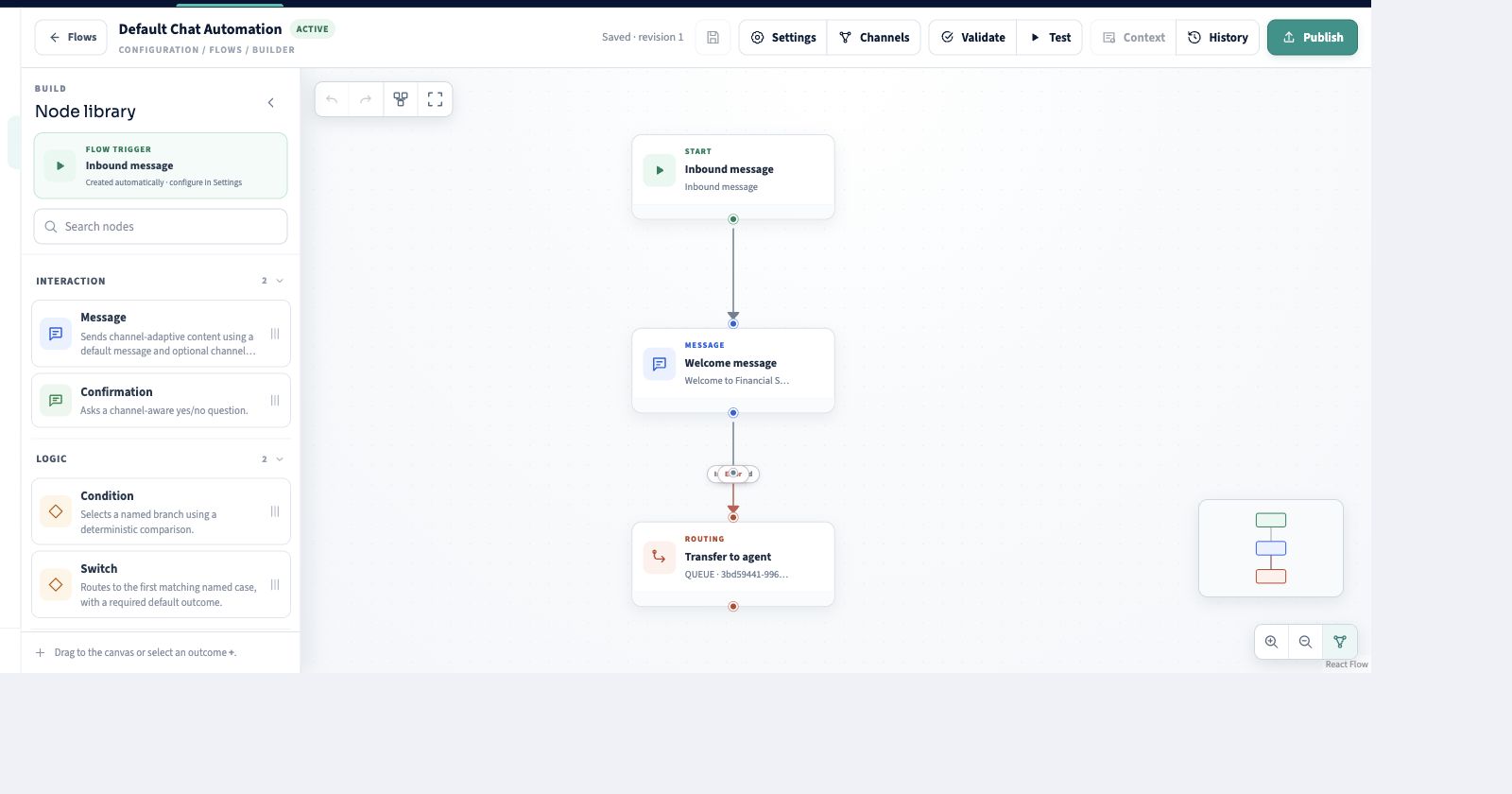
Versioned automation with validation, testing, routing, and controlled publication.
- 01
Explicit journey logic
Deterministic nodes and managed AI steps share one model.
- 02
Human handoff
Routing is a visible part of the journey rather than a hidden script.
- 03
Lifecycle controls
Validate, test, review history, and publish through defined gates.
- 04
Version evidence
Published behavior remains traceable to an immutable revision.
Industry operating capabilities
Connect the journey to the responsibilities behind it.
The industry pattern stays useful only when product capability, system authority, and accountable operating ownership remain visible together.
- 01Workspace isolation
- Separate customer data, configuration, identity, providers, operations, and evidence by program.
- 02Repeatable program release
- Version journey, routing, provider, queue, desktop, and support configuration before activation.
- 03Role-aware operations
- Give agents and supervisors only the program scope and actions they are assigned.
- 04Comparable evidence
- Use common health, change, quality, and support gates without collapsing client authority.
Workflow
Make the operating sequence explicit.
The workflow connects customer context, service work, system boundaries, and governance requirements.
- 01
Define the boundary
Establish workspace, data, identity, provider, and operational ownership per program.
- 02
Validate the journey
Test flows, routing, human handoff, failure paths, and observability before activation.
- 03
Operate with evidence
Track service work, change, quality, provider dependencies, and support readiness.
System boundaries
- Client-specific workspace
- Client CCaaS and CRM estate
- Shared BPO operating services
- Provider-specific credentials and endpoints
Governance requirements
- Tenant-isolated data paths
- Versioned program configuration
- Provider certification register
- Engineering-to-operations acceptance
Adoption and evaluation
Move from operating fit to controlled rollout.
Use the adoption path to structure a first workflow, then resolve the questions that determine authority, risk, and production readiness.
- 01
Create the boundary
Define workspace, identity, data, provider, staffing, client authority, and support ownership.
- 02
Package and validate
Promote versioned journeys and configuration through synthetic test and acceptance evidence.
- 03
Hand over to operations
Confirm dashboards, alerts, runbooks, escalation, rollback, and client-specific access before launch.
- 01Which assets may be standardized and which remain client-owned or client-specific?
- 02How are data, credentials, provider endpoints, routing, staff scope, and evidence isolated per program?
- 03What constitutes engineering, operations, security, and client acceptance before production traffic?
Design-partner observation
Qualitative validation without unsupported outcome claims.
This observation is anonymous, approved, and intentionally non-quantified.
Design-partner observation
“Versioned journeys and explicit provider gates gave technology and operations teams a shared language for release readiness.”
Anonymous design partner
BPO and outsourcing · Automation and deployment design session
Enterprise evaluation
Evaluate the BPO & Outsourcing operating model in your environment.
We tailor the walkthrough to your operating model, current stack, provider constraints, and governance requirements.