Standardize evaluation
Apply published scorecards, weighted criteria, sampling policy, and evidence to customer interactions.
Bring schedule, adherence, evaluation, calibration, dispute, coaching, and supervisor workflows into the same governed operating context as customer work.
Workforce and quality operating journey
Select
Policy and risk signals identify the work that requires review.
Evaluate
A reviewer applies the rubric with evidence and accountable judgment.
Improve
Coaching and operational action remain linked to the finding.
For 01
Operations leaders
For 02
Quality leaders
For 03
Workforce teams
Where it fits
Connect this responsibility to the customer context, work, knowledge, policy, and evidence shared across OCXCenter.
Apply published scorecards, weighted criteria, sampling policy, and evidence to customer interactions.
Use risk, confidence, and operational signals to prioritize work while retaining accountable judgment.
Turn findings into owned coaching, acknowledgement, calibration, dispute, and follow-through.
Product evidence
Review where context, action, ownership, and control meet during the work.
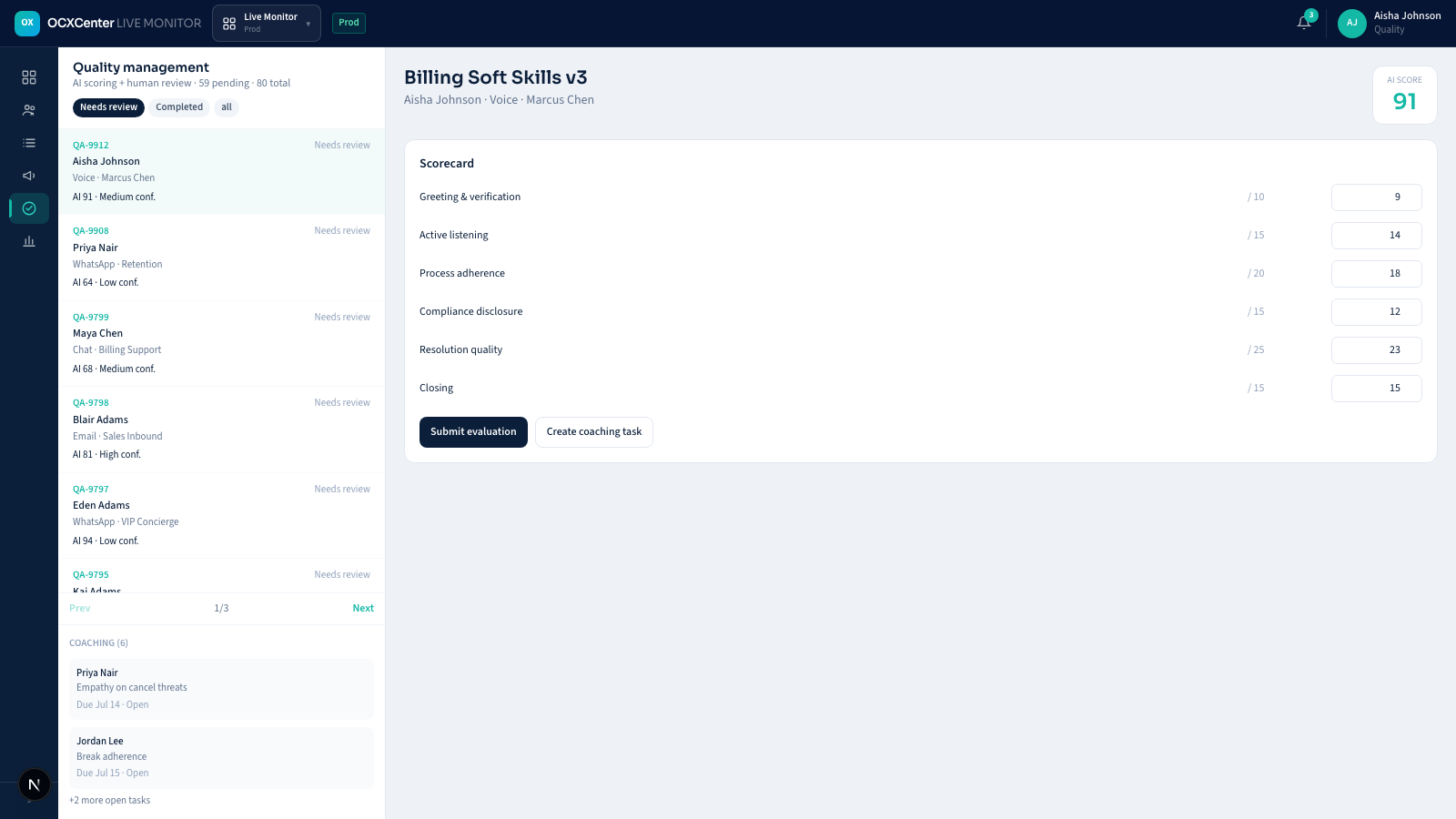
Human review, structured scorecards, AI evidence, and coaching follow-through.
Review population
Evaluations are prioritized with confidence and status context.
Defensible rubric
Weighted criteria keep evaluation logic visible to reviewers.
Human decision
AI scores support rather than replace the accountable reviewer.
Coaching action
Evaluation findings can become owned coaching work.
Operating capability
Capabilities connect to the same customer journey rather than operating as isolated add-ons.
How work moves
Every stage has a clear owner, transition, and retained evidence.
Policy and risk signals identify the work that requires review.
A reviewer applies the rubric with evidence and accountable judgment.
Coaching and operational action remain linked to the finding.
Move quality from isolated scoring into a defensible improvement loop connected to real service outcomes.
Role-specific workflows
Keep responsibilities clear while the customer journey remains connected.
Operations leaders
01Policy and risk signals identify the work that requires review.
Quality leaders
02A reviewer applies the rubric with evidence and accountable judgment.
Workforce teams
03Coaching and operational action remain linked to the finding.
Adoption path
Sequence configuration, integration, testing, and rollout around measurable service outcomes.
Agree populations, scorecards, reviewer roles, evidence, privacy, disputes, and coaching expectations.
Authorize interaction metadata, transcripts, recordings, outcomes, schedules, and relevant customer context.
Run human calibration, review AI-supported decisions, confirm access, and phase coverage by risk.
Evaluation questions
Enterprise integration and governance
Review integration boundaries and governance controls together so deployment assumptions remain explicit.
Connected product family
Continue the customer journey.
Evaluate it as one system