Insurance service
Connect complex resolution, quality, and customer feedback
Coordinate policyholder interactions, case lifecycles, line-item work, service terms, quality review, and follow-up across a shared operating record.
Designed for Service, claims operations, technology, and quality leaders. All provider, deployment, and contractual requirements remain explicit.
Operating journey
Insurance
- 01
Capture the request
- 02
Coordinate resolution
- 03
Review the outcome
Teams in the review
Service, claims operations, technology, and quality leaders
Operating scenario
Follow one service journey end to end.
A coverage or billing request moves across frontline service and back-office work while milestones, ownership, evidence, and customer communication remain connected.
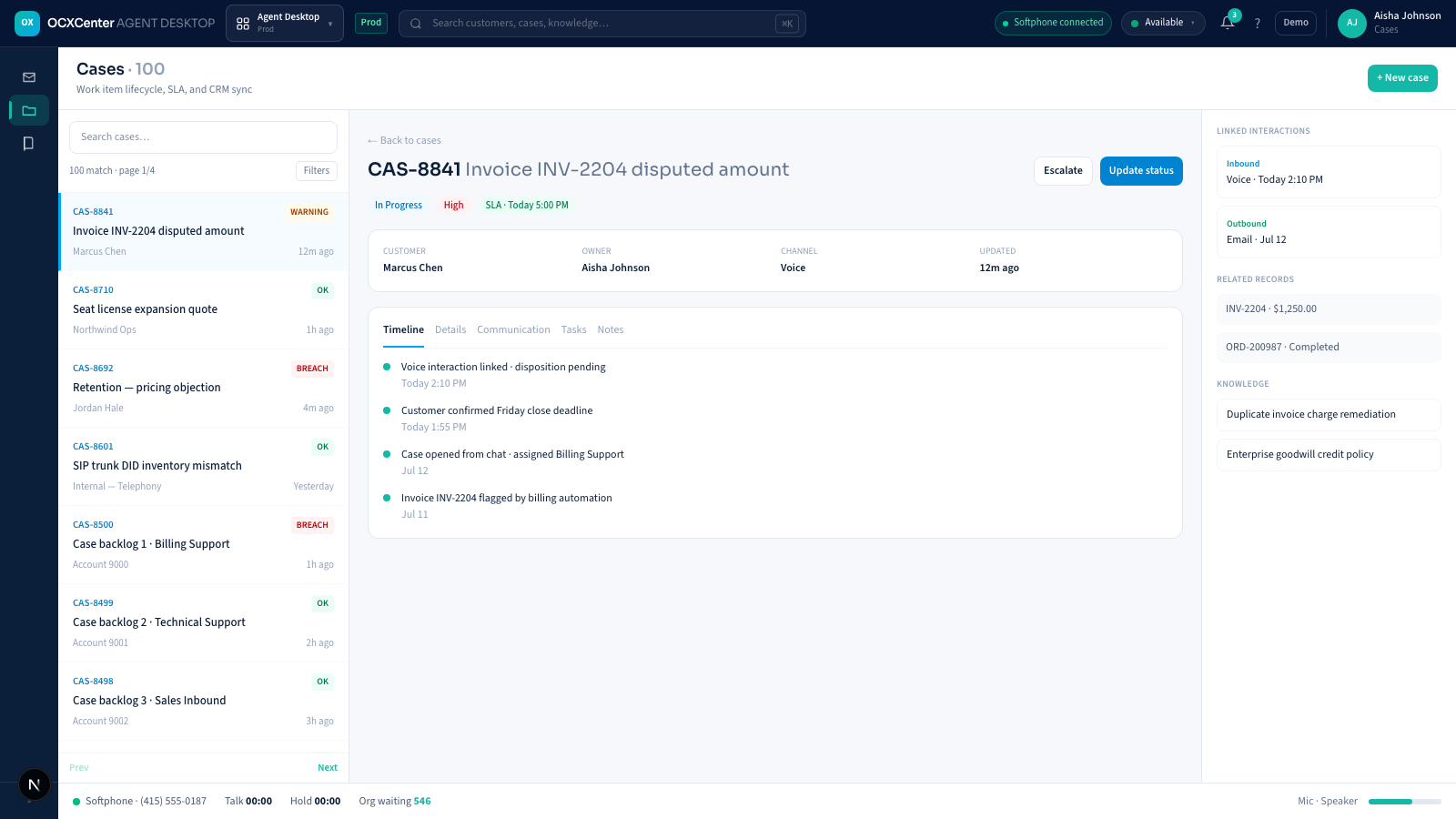
Case ownership, timeline, related records, knowledge, and SLA state in one resolution workspace.
- 01
Prioritized portfolio
Open work is ranked with warning and breach visibility.
- 02
Resolution timeline
Customer, automation, and agent actions share one history.
- 03
Related records
Interactions, orders, invoices, and knowledge remain linked.
- 04
Governed state
Ownership, priority, SLA, and status changes remain explicit.
Industry operating capabilities
Connect the journey to the responsibilities behind it.
The industry pattern stays useful only when product capability, system authority, and accountable operating ownership remain visible together.
- 01Connected policyholder context
- Keep the interaction, policy or claim reference, related records, and active work connected.
- 02Governed case lifecycle
- Version states, tasks, milestones, line items, approvals, and customer acceptance.
- 03Business-time accountability
- Apply calendars, warning thresholds, pause rules, escalation, and ownership.
- 04Quality and feedback loop
- Relate review, coaching, survey feedback, reopen events, and resolution outcomes.
Workflow
Make the operating sequence explicit.
The workflow connects customer context, service work, system boundaries, and governance requirements.
- 01
Capture the request
Preserve the interaction, customer intent, related records, and initial ownership.
- 02
Coordinate resolution
Route tasks, milestones, evidence, line items, and approvals through the case lifecycle.
- 03
Review the outcome
Relate quality, feedback, reopened work, and coaching to the final resolution.
System boundaries
- Policy or claims system
- CRM and case authority
- Contact center provider
- Document and knowledge systems
Governance requirements
- Versioned case lifecycle
- Business-time milestones
- Evidence and acceptance history
- Private quality and coaching data
Adoption and evaluation
Move from operating fit to controlled rollout.
Use the adoption path to structure a first workflow, then resolve the questions that determine authority, risk, and production readiness.
- 01
Define the service model
Map interaction intake, case types, policy systems, documents, milestones, roles, and outcomes.
- 02
Connect resolution work
Link agents, automation, routing, back-office tasks, approvals, and customer communication.
- 03
Validate outcome evidence
Prove SLA, authorization, concurrency, audit, feedback, reopen, and recovery behavior.
- 01Which system owns the policy, claim, billing record, case state, and final customer outcome?
- 02Which milestones, calendars, approvals, and acceptance rules define an on-time resolution?
- 03How will quality and customer feedback remain connected without exposing private coaching or response data?
Design-partner observation
Qualitative validation without unsupported outcome claims.
This observation is anonymous, approved, and intentionally non-quantified.
Design-partner observation
“Bringing interaction context, case ownership, and governed follow-up into one operating view made the next action easier to review across service teams.”
Anonymous design partner
Financial services · Agent and case operating-model review
Enterprise evaluation
Evaluate the Insurance operating model in your environment.
We tailor the walkthrough to your operating model, current stack, provider constraints, and governance requirements.