Financial services
Govern customer service from conversation through final resolution
Connect identity, consent, interaction context, recording policy, case ownership, approvals, and audit evidence while preserving explicit system authority.
Designed for CX, technology, operations, and risk leaders. All provider, deployment, and contractual requirements remain explicit.
Operating journey
Banking & Fintech
- 01
Verify and understand
- 02
Act with control
- 03
Close with evidence
Teams in the review
CX, technology, operations, and risk leaders
Operating scenario
Follow one service journey end to end.
A billing dispute begins in an automated journey, reaches an agent with verified context, continues as a case, and closes only after the committed action is recorded.
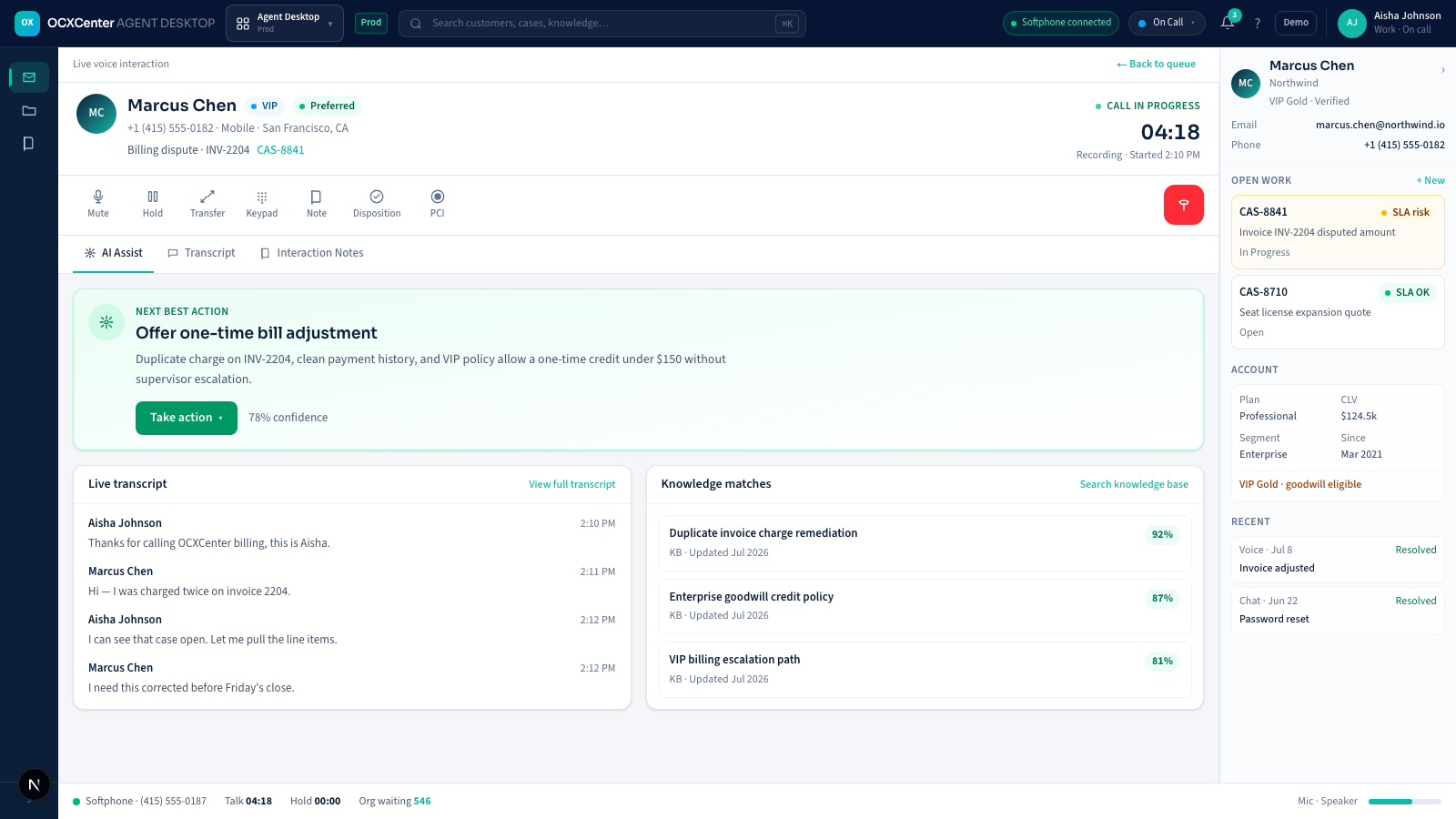
Live interaction controls, transcript, knowledge, and customer context without tab switching.
- 01
Interaction controls
Mute, hold, transfer, keypad, notes, disposition, and PCI controls.
- 02
Grounded assistance
Suggested actions remain reviewable and confidence-labeled.
- 03
Live transcript
The conversation is available beside the service workflow.
- 04
Knowledge matches
Relevant guidance is ranked without obscuring the customer record.
Industry operating capabilities
Connect the journey to the responsibilities behind it.
The industry pattern stays useful only when product capability, system authority, and accountable operating ownership remain visible together.
- 01Verified service context
- Bring identity, consent, account, interaction, and open-work context into the authorized workflow.
- 02Controlled assistance
- Use approved knowledge, guidance, recording policy, and explicit agent confirmation.
- 03Case-backed resolution
- Continue disputes, exceptions, approvals, and commitments through owned case work.
- 04Reviewable evidence
- Relate service actions, configuration versions, provider activity, and final outcome.
Workflow
Make the operating sequence explicit.
The workflow connects customer context, service work, system boundaries, and governance requirements.
- 01
Verify and understand
Resolve the customer, consent, account, open work, and relevant service history.
- 02
Act with control
Use approved guidance, recording policy, and authorized service actions.
- 03
Close with evidence
Retain the disposition, case outcome, customer commitment, and audit context.
System boundaries
- Core banking and CRM authority
- CCaaS and media provider
- Identity provider
- Approved AI and knowledge providers
Governance requirements
- Tenant and role isolation
- Consent-aware contact
- Recording and playback policy
- Audited service and administrative actions
Adoption and evaluation
Move from operating fit to controlled rollout.
Use the adoption path to structure a first workflow, then resolve the questions that determine authority, risk, and production readiness.
- 01
Map authority
Identify systems of record, identity, consent, payment, recording, and approval responsibilities.
- 02
Prove one journey
Connect automation, agent work, case handling, and evidence for a bounded service scenario.
- 03
Certify controls
Validate access, provider, data, recovery, operational, and contractual requirements before expansion.
- 01Which core system remains authoritative for the customer, account, and financial action?
- 02Where must consent, recording, authentication, or maker-checker approval interrupt the journey?
- 03Which interaction, case, provider, and administrative evidence must remain available for review?
Design-partner observation
Qualitative validation without unsupported outcome claims.
This observation is anonymous, approved, and intentionally non-quantified.
Design-partner observation
“Bringing interaction context, case ownership, and governed follow-up into one operating view made the next action easier to review across service teams.”
Anonymous design partner
Financial services · Agent and case operating-model review
Enterprise evaluation
Evaluate the Banking & Fintech operating model in your environment.
We tailor the walkthrough to your operating model, current stack, provider constraints, and governance requirements.